
It’s 2026, and AI isn’t just part of the innovation agenda – it’s showing up in boardroom discussions, budget allocations, and real operational workflows. But while more companies are experimenting with AI, far fewer are turning those experiments into long-term business value.
What does successful AI adoption look like in practice?
This article explores that question by looking at real enterprise case studies across industries where AI has moved past the pilot phase and is delivering measurable results. Along the way, we’ll examine the current state of AI in business, the most common AI adoption challenges, and the value of following a structured AI adoption framework to avoid common pitfalls.
Whether you’re building your first AI use case or scaling what’s already working, these examples offer practical insight into what it really takes.
According to the McKinsey Global Survey on AI, 72% of enterprises have adopted at least one AI capability. That’s a major jump from 20% in 2017, showing that AI has become a near-universal priority.
But ambition doesn’t guarantee results. Only 23% of companies report significant cost savings from their AI initiatives. And fewer still can point to AI as a key driver of revenue or competitive advantage.
To see how a structured approach leads to measurable value, download our Amerit Fleet case study to learn how we delivered a 10x ROI and six-figure annual savings through data science.
.gif)
Additional AI adoption statistics 2026 underline this gap:
But that investment won’t pay off without solving the biggest AI adoption challenges, including:
That’s why many companies are turning to structured strategies and playbooks. Using a proven ai adoption framework allows organizations to de-risk early pilots, define measurable outcomes, and set realistic expectations for scalability. If you're looking for a place to start, the AI Playbook is a practical guide that outlines each phase of the adoption journey — from early use case discovery to successful deployment and integration.
Now, let’s look at what success really looks like.
Enterprise adoption of artificial intelligence is delivering measurable results across sectors. The following case studies illustrate how leading companies have successfully deployed AI solutions and the impact those initiatives have had.
Walmart, the world’s largest retailer, has used AI and advanced analytics to enhance its supply chain, specifically in truck routing and load optimization. In 2023, its in-house AI system earned the INFORMS Franz Edelman Award for operational excellence.
BMW integrated AI-powered computer vision into its assembly lines, enabling real-time inspections of vehicle components and final products.
JPMorgan developed an AI system called COIN (Contract Intelligence) to automate document review processes, particularly for complex loan agreements.
CarMax partnered with OpenAI through Microsoft’s Azure service to enhance customer experiences using GPT-3.
Shell uses AI to predict and prevent equipment failures, increasing uptime and safety across its oil and gas operations.
It is useful to see what massive corporations like Walmart and Shell are doing, but it is often harder to see how those examples apply to a specific product roadmap. So, here is how three of our NineTwoThree partners used AI to solve specific problems, and the results they saw.
Amerit Fleet manages maintenance for massive vehicle fleets across the country. Their operations team faced a significant bottleneck: manually reviewing thousands of repair orders to catch billing errors and data inconsistencies. NineTwoThree engineered a custom AI model that doesn't just digitize the process but "reads" the context of every repair order to flag anomalies.

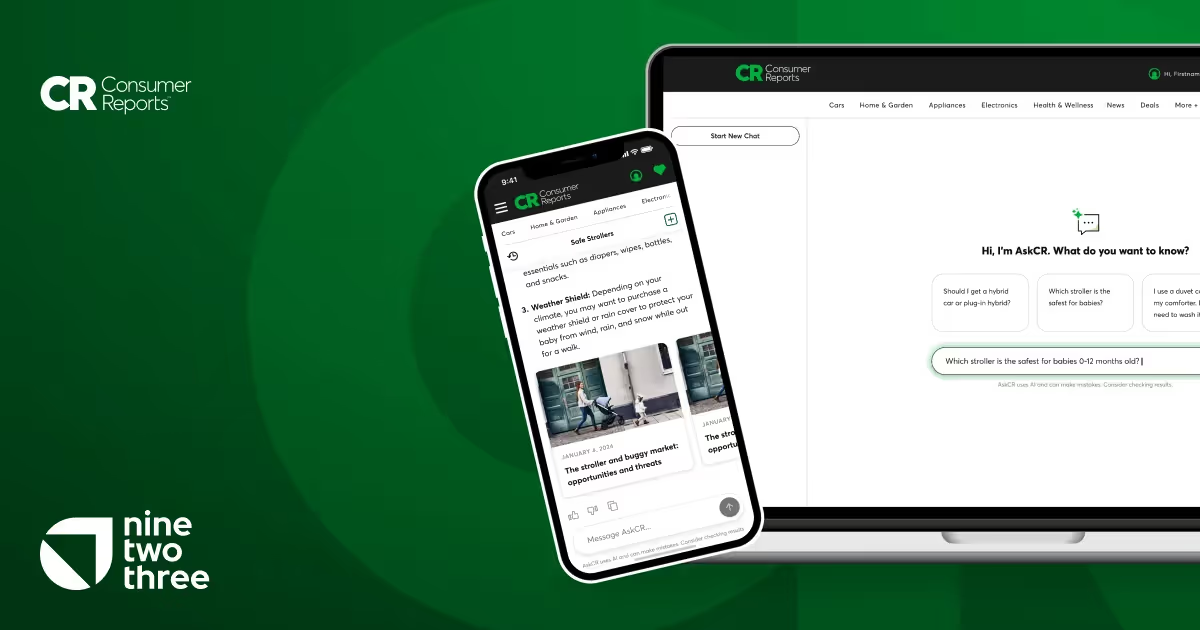
Consumer Reports (CR) holds nearly a century of unbiased product reviews. They wanted to make this data accessible via a conversational AI but could not risk their reputation on a model that might "hallucinate" fake safety ratings. NineTwoThree worked with CR’s Innovation Lab to build "AskCR," a Retrieval-Augmented Generation (RAG) system that answers complex questions using only CR’s trusted archives.
FanDuel wanted to extend their "ChuckGPT" television campaign—featuring Charles Barkley—into a digital experience where fans could actually chat with the NBA legend. The challenge wasn't just personality; it was scale. The system had to handle the massive, sudden spikes in traffic that come with a Super Bowl campaign without crashing or breaking character.
Looking across these implementations, the successful ones share some key characteristics that separate real results from pilot program theater:
None of these companies deployed AI because it was trendy. Walmart needed better logistics. BMW needed higher quality. JPMorgan needed faster contract review. Each solution targets a clear business challenge with measurable costs.
Every successful case involved companies that already had solid data infrastructure. AI amplifies what you have—if your data is messy, your AI will be messy too.
Notice that none of these systems run fully autonomous. BMW's quality system works with human inspectors. JPMorgan's COIN freed up lawyers for more complex work. The AI handles the routine stuff so humans can focus on judgment calls.
Each example comes with specific numbers: dollars saved, hours eliminated, defects caught, predictions made. Without clear metrics, you can't tell success from expensive experimentation.
The most successful implementations have a path from proof of concept to full deployment. Walmart turned theirs into a product. Shell scaled to 10,000 assets. CarMax integrated theirs into the customer experience. Pilot programs that can't scale aren't really solutions.
When done well, enterprise AI adoption delivers more than efficiency. It creates confidence. Teams can act faster, make smarter decisions, and serve customers better, because they’re no longer guessing.
Whether you’re just starting out or ready to scale, the message is clear: AI works when you make it a business strategy, not just a tech initiative.
Ready to prove the business value of your next AI initiative? Download the full Amerit Fleet ROI case study to see our implementation deep-dive and get an actionable cheat sheet to calculate your own potential savings


.jpg)